
Sun news September 5: Bam bam! The sun issues a 1-2 punch


Today’s top story: The sun surprised us with two blasts in sequence, like a 1-2 punch, with one blast from the sun’s northeast horizon and one from the southeast. The first erupted near sunspot region AR4524. It started at around 19 UTC on September 4, and it came with a C6.7 flare. The second blast, in the southeast, started at around 20:56 UTC on September 4, almost right on the heels of the first. No visible flare accompanied this one, meaning it must have erupted just behind the sun’s limb, or edge, from an active region whose arrival on the Earth-facing disk is imminent. Both prominences hurled solar plasma into space. But initial analyses suggest the resulting coronal mass ejections (CMEs) are not Earth-directed. Stay tuned!
Past 24 hours on the sun
(11 UTC September 4 – 11 UTC September 5)
Flare activity: Solar activity returned to low levels, with only C-class and B-class events. Over the past day, our star sparked a total of seven flares: 5 C flares and 2 B flares.
- Strongest flare: A C7.1 from AR4525 at 11:29 UTC on September 4.
- Other notable C flares: A C6.7 at 19:30 UTC on September 4 from AR4524. A C2.1 at 13:05 UTC on September 4 from AR4527. And a C1.3 at 15:27 UTC on September 4 from AR4518.
- Lead flare producer: Two sunspot regions ended tied at the top of the list, firing two flares each: AR4525 and AR4526.
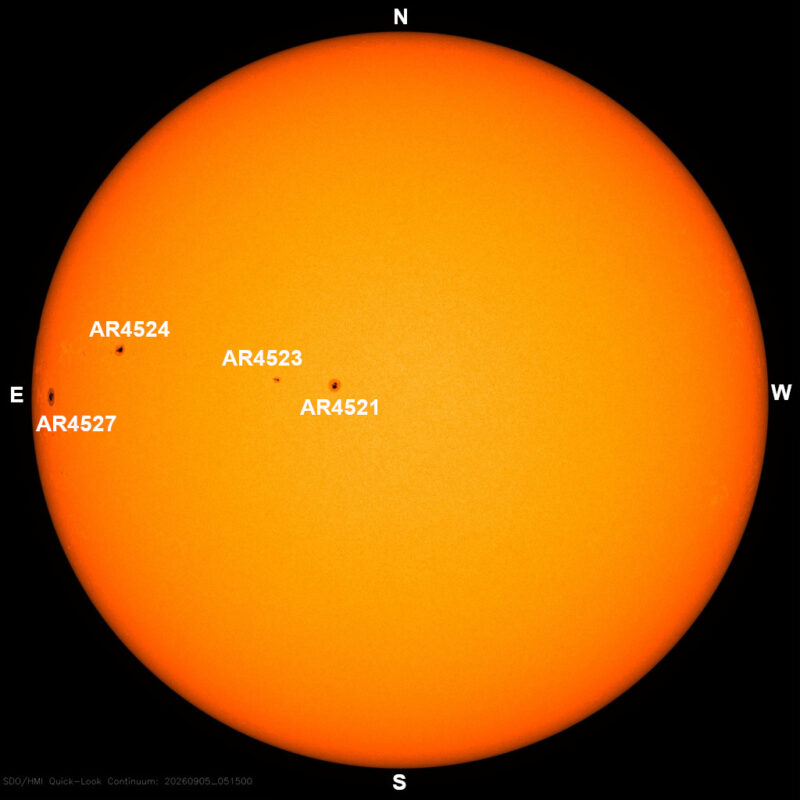
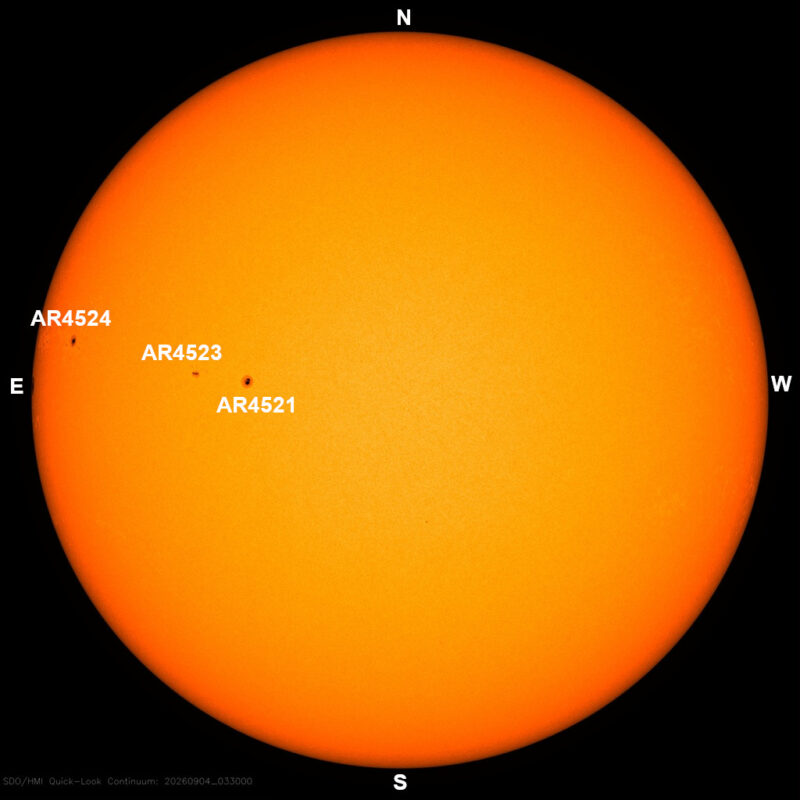
Sunspot regions: Currently, the Earth-facing solar disk displays 4 numbered sunspot regions. One is a newcomer on the northeast limb, labeled AR4527.
- AR4521 (alpha): This region stayed stable and quiet throughout the period. It produced no notable flares.
- AR4523 (alpha): This region showed some growth over the past 24 hours. However, it produced no flares this time.
- AR4524 (beta): This region showed some growth. It also produced a C flare during this period.
- AR4527 (alpha): This newcomer received its number during the period. It needs to rotate further into view for a better analysis. Even so, it has already produced a C flare.
Blasts from the sun? Observers spotted multiple coronal mass ejections (CMEs) yesterday and today. The fiery prominences we saw should not hit Earth directly. But, given their size, they might carry a component that might reach us. Any impact would be minor at best. Modeling and analysis of these events continue.
Past 24 hours in space weather
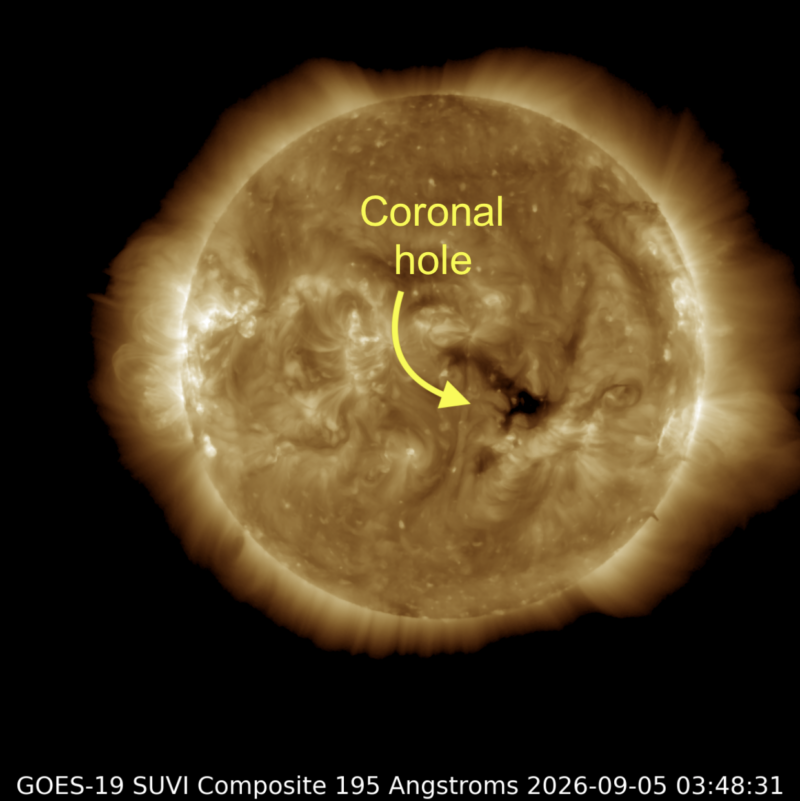
Solar wind: Solar wind parameters reflected mostly normal, slow-wind conditions throughout the period. Meanwhile, an equatorial coronal hole has reached a geoeffective position at the center of the Earth-viewed solar disk. Its high-speed stream may begin impacting our magnetic field in the coming days.
Bt, Bz and magnetic coupling: The interplanetary magnetic field (IMF) total strength (Bt) ran slightly elevated, at moderate levels. Meanwhile, the Bz pointed north early in the period. Then, at 22:30 UTC on September 4, it shifted southward and held that direction for the rest of the period. That kept conditions favorable for aurora production. At the time of this writing, the Bz still points south.
Earth’s magnetic field: Earth’s magnetic field stayed quiet-to-unsettled throughout the period, with the Kp index at 0 to 3. No geomagnetic storm conditions occurred. As of this writing, the Kp index sits just below level 3.
What’s ahead? Sun–Earth forecast
Flare activity forecast: Forecasters expect a slight increase in solar activity after yesterday’s M flare. The chance of an M flare rose to 20% today, up from 10% yesterday. AR4523, AR4524, and AR4525 are the main players. These regions do not show strong magnetic complexity. Still, they have already produced M- and C-class flares and fiery prominences. A 1% chance exists for an isolated X-class (R3) event.
Geomagnetic activity forecast:
- September 5: Expect mostly quiet conditions (Kp 1-2), with a slight chance of unsettled intervals (Kp 3) if a glancing CME arrives around 18:00 UTC. That carries low confidence. Aurora is unlikely outside the polar regions.
- September 6-7: Conditions might become more interesting. A possible weak CME arrival around 16:00 UTC on September 6 (Kp 2 to 3) and potential coronal hole high-speed stream effects could combine to push activity to unsettled-to-active levels (Kp 3-4). A slight chance exists for isolated G1 (minor) storm intervals (Kp 5). If G1 conditions materialize, aurora may appear over Seattle, Edinburgh, southern Alaska, and similar high-latitude locations. The UK Met Office notes slight auroral enhancements may be possible across the far north of Scotland and similar latitudes during this window.
Sun news September 4: More action from returning sunspot region

An exciting sunspot region emerging from the sun’s northeast horizon continued making its presence felt over the past day. Numbered AR4524, this region fired off an M1.2 flare at 7:45 UTC this morning, the strongest event of the 24-hour period. This same region had earlier produced a C7.9 flare with a powerful eruption of sun-stuff, which is heading well away from Earth. This sunspot group appears to have already passed across the face of the sun in mid-August, before rotating around our star’s far side. Now, it’s returning over the eastern horizon. On its last passage, it had an impressive magnetic complexity. As it rotates back into full view within the next day, we’ll be able to see how much potential it’s held on to.
Past 24 hours on the sun
(11 UTC September 3 – 11 UTC September 4)
Flare activity: Solar activity reached moderate levels. Observers logged 11 flares: 1 M-class and 10 C-class events.
- Strongest flare: An M1.2 from AR4524 at 7:45 UTC on September 4. It triggered an R1 (minor) radio blackout, briefly affecting high-frequency communications over the Arabian Sea.
- Other notable flares from AR4524: C7.9 at 16:13 UTC on September 3, C2.0 at 17:00 UTC on September 3, C1.3 at 06:08 UTC on September 4.
- Lead flare producer: AR4523 topped the list, firing 6 C-class flares.
Sunspot regions: The Earth-facing solar disk displayed 3 numbered sunspot regions. A fourth should rotate into view imminently from beyond the northeast limb.
- AR4521 (alpha): This region stayed stable and quiet throughout the period. It produced no notable flares.
- AR4523 (beta): This region grew over the past 24 hours. It was also the most prolific flare producer, generating multiple C-class events up to C6.9. So it bears watching as it continues to develop.
- AR4524 (alpha): This returning region currently sits near the east limb. It produced the period’s strongest flare, the M1.2, plus the notable C7.9 event. It was magnetically complex during its previous disk transit in mid-August. So it may regain that complexity as it rotates further into view, raising the prospect of stronger flaring.
- In addition, bursts of sun-stuff from beyond the eastern limb during the period confirms that a significant active region is about to rotate onto the visible disk, likely within the next 24 hours.
Blasts from the sun? Observers spotted multiple coronal mass ejections (CMEs) during the period. However, none should directly hit Earth. Two earlier CMEs from September 2 carry the potential to reach us, but impacts would be minor at best.
Past 24 hours in space weather
Solar wind: Solar wind parameters reflected mostly normal, slow-wind conditions throughout the period. Meanwhile, an equatorial coronal hole has reached the center of the Earth-viewed sun. Its high-speed stream may begin impacting our magnetic field in the coming days.
Bt, Bz and magnetic coupling: The interplanetary magnetic field (IMF) total strength (Bt) was slightly elevated. Meanwhile, the Bz component fluctuated between north and south. That kept Earth’s magnetic shield largely intact and conditions unfavorable for aurora production.
Earth’s magnetic field: Earth’s magnetic field stayed quiet throughout the period, with the Kp index remaining at 1 to 2. No geomagnetic storm conditions occurred.
Sun news September 3: Big flare from newcomer sunspot


Bam! A newcomer sunspot region sparked an impressive M3.0 flare around 19:20 UTC last night. This region is just showing its nose on the northeast solar horizon. It was unnumbered at the moment of the flare, but it’s now been labeled AR4524. This region started showing off its potential with a fiery prominence we reported a couple of days ago. Now, it’s the region to watch. The M3 flare did hurl plasma into space, but this coronal mass ejection (CME) doesn’t appear to be coming our way. But once AR4524 rotates toward the center of the solar disk, a flare like this could sent material toward Earth. Stay tuned.
Past 24 hours on the sun
(11 UTC September 2 – 11 UTC September 3)
Flare activity: Solar activity jumped to moderate levels, thanks to the M-class flare. Over the past day, our sun produced a total of 12 flares: the M3, four C-class (common) flares, and seven B-class (weak) flares.
- Strongest flare: An M3.0 from the incoming northeast region, now numbered AR4524, at 19:20 UTC on September 2.
- Lead flare producer: That same newcomer, AR4524, reached the top of the list with eight flares this period: the M flare, all four C flares of the period, plus three B flares.
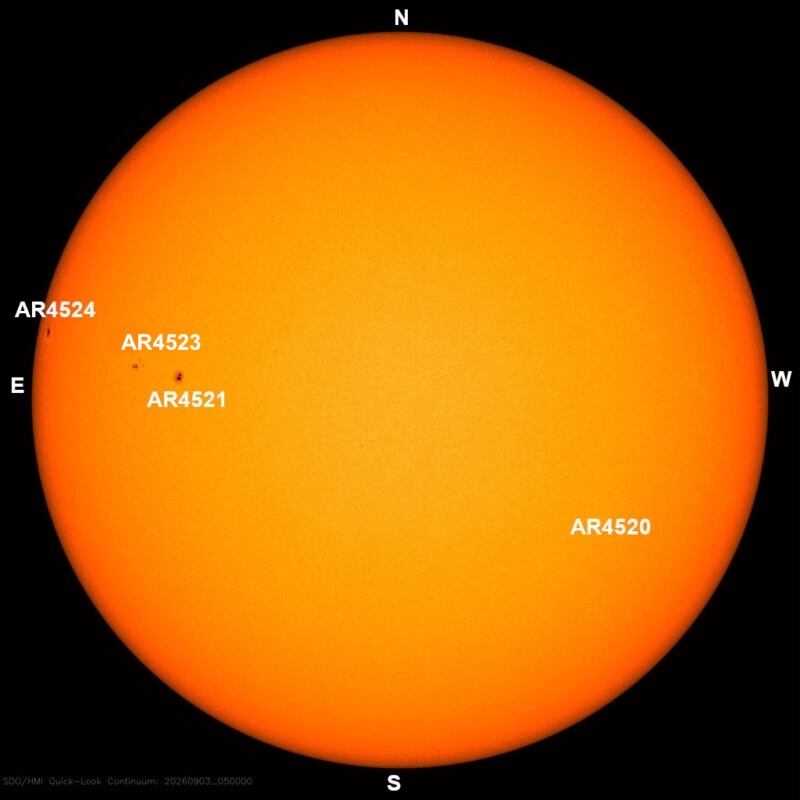
Sunspot regions: From Earth, we see four numbered sunspot regions on the solar disk. There is a newcomer on the solar disk: AR4524.
- AR4520 (beta): This region’s magnetic configuration stayed stable. It produced only one B flare during the period.
- AR4521 (alpha): This region kept relatively stable and produced no flares.
- AR4523 (beta): This region produced three B flares during the period.
- AR4524 (alpha): This region sits close to the northeast horizon. It rapidly became the lead flare producer and sparked a strong M3.0 flare. This is the guy to keep watching in the coming days.
Blasts from the sun? The M3.0 event from AR4524 clearly hurled plasma into space. The bulk of that coronal mass ejection (CME) lies off the sun-Earth line. Nevertheless, modeling and analysis continue to determine whether any component is coming our way. Separately, a filament eruption at 9:08 UTC on September 2 produced a CME. Initial analysis suggests a glancing blow is possible on September 7.
Past 24 hours in space weather
Solar wind: Solar wind speeds continued at low levels. The influence of the coronal hole high-speed stream has vanished. No significant space weather to report this time.
Bt, Bz and magnetic coupling: The interplanetary magnetic field started our observation period at weak levels. Then, at 7 UTC this morning, it spiked briefly to moderate levels before dropping back to weak. Meanwhile, the Bz component kept fluctuating between south and north orientations throughout the period, with north dominating. As always, prolonged southward Bz periods favor auroras by letting solar wind energy couple more efficiently with Earth’s magnetosphere. At the time of this writing, the Bz still points northward.
Earth’s magnetic field: Earth’s magnetic field showed quiet levels during the period, with the Kp index at 1 to 2. At the time of this writing, the Kp index sits just at level 1.
Sun news September 2: New update for Solar cycle 25

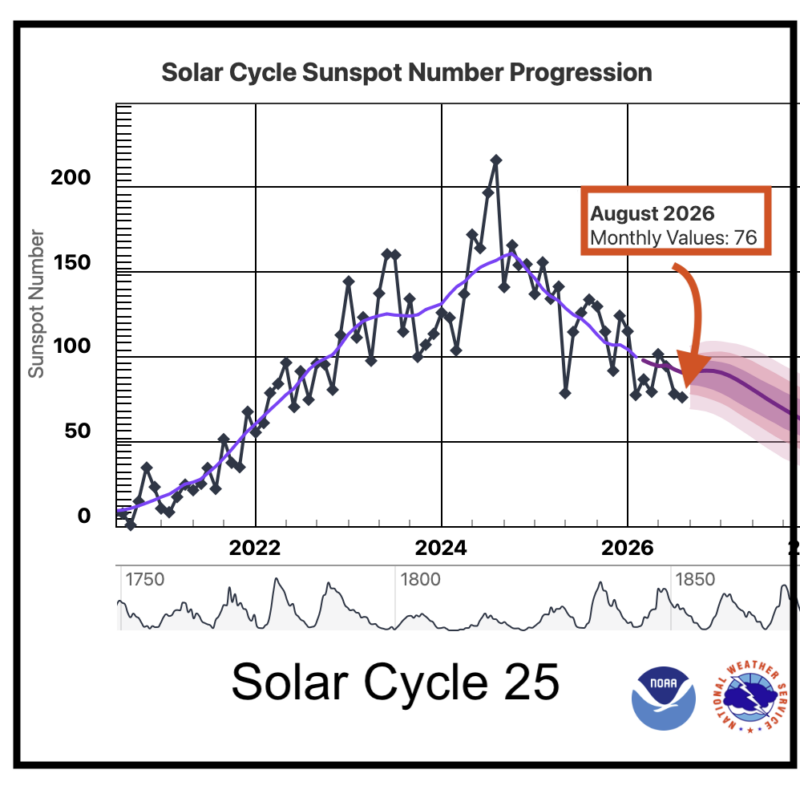
The NOAA Space Weather Prediction Center just released its solar cycle progression results for August 2026. The monthly sunspot number slipped slightly to 76, compared to 78.1 in July 2026. Meanwhile, August 2024 still stands as the peak of Solar Cycle 25. Since then, the cycle has been in its declining phase. Even so, as the past two weeks showed, a declining sun can still deliver plenty of action.
Past 24 hours on the sun
(11 UTC September 1 – 11 UTC September 2)

Flare activity: Solar activity stayed at low levels, with only faint C-class and B-class flares. Over the past day, our sun produced a total of seven flares: three C-class (common) flares plus another four B-class (weak) flares.
- Strongest flare: A C5.7 from an incoming, as-yet-unnumbered region in the northeast at 21:10 UTC on September 1.
- Lead flare producer: That same northeast newcomer, still awaiting its number, topped today’s list. It produced four flares (two Cs and two Bs) including the strongest of the period.
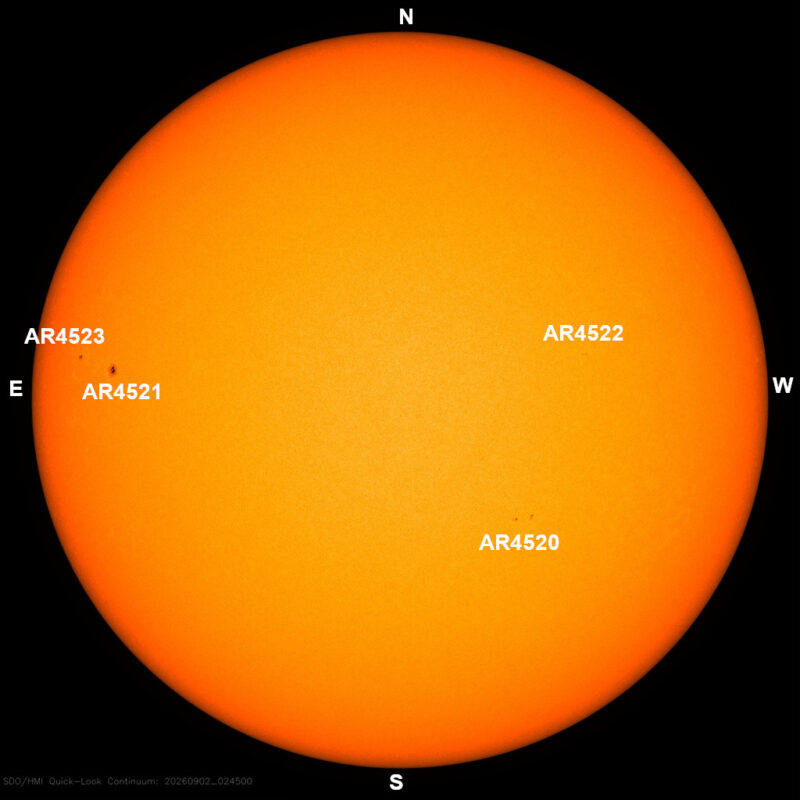
Sunspot regions: The solar disk, as we see it from Earth, shows five numbered sunspot regions today.
- AR4518 (alpha): This region has decayed to a simple alpha magnetic configuration. Just yesterday it was the only region showing growth. Now it produced no flares.
- AR4520 (beta): This region stayed stable, though it showed signs of decay. It produced only one B flare during this period.
- AR4521 (alpha): This region kept relatively stable.
- AR4522 (beta): This region is in decay and produced no flares.
- AR4523 (alpha): This region stayed stable with no flare production.
Blasts from the sun? Forecasters reported no Earth-directed coronal mass ejections (CMEs) in the last 24 hours.
Past 24 hours in space weather
Solar wind: Solar wind speeds continued slowly decreasing, from moderate-low to low levels. The influence of the coronal hole high-speed stream has almost vanished, as space weather conditions drop back to background levels.
Bt, Bz and magnetic coupling: The interplanetary magnetic field continued at weak levels. Meanwhile, the Bz component fluctuated between south and north orientations throughout the period. Neither direction dominated, since the Bz held each orientation only briefly. As always, prolonged southward Bz periods favor auroras by letting solar wind energy couple more efficiently with Earth’s magnetosphere. At the time of this writing, the Bz has shifted southward.
Earth’s magnetic field: Earth’s magnetic field held at quiet-to-unsettled levels during the period, with the Kp index at 1 to 3. Any visible aurora displays would have stayed confined to high latitudes such as northern Scandinavia, Iceland, and northern Canada. At the time of this writing, the Kp index sits just at level 2.
Sun news September 1: Sun-observing spacecraft sees a solar eclipse
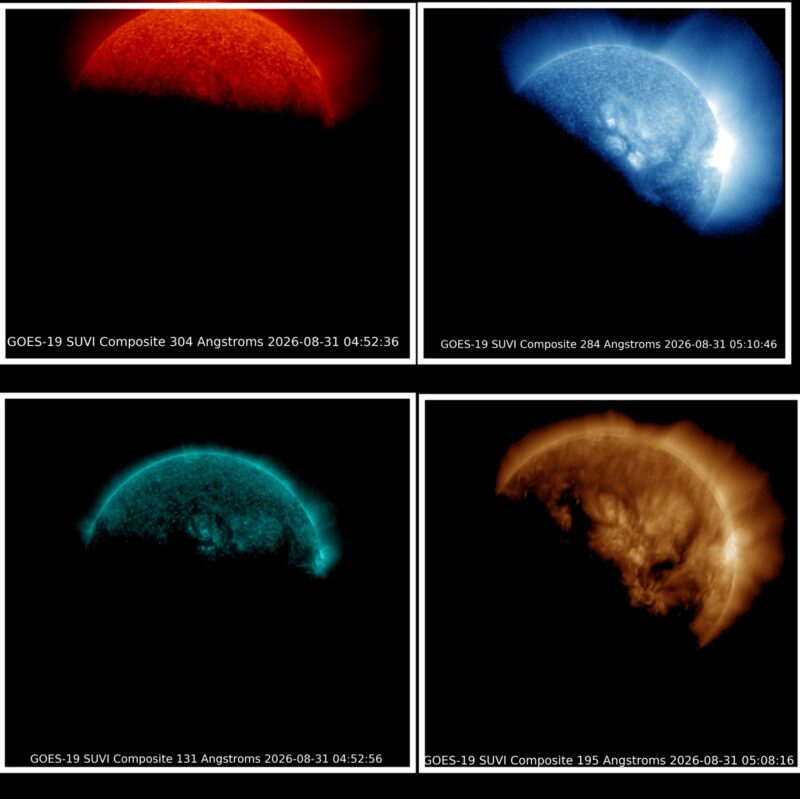
The solar observations from NOAA’s GOES-19 spacecraft were interrupted over the past day. That’s because Earth passed in front of our star from the satellite’s perspective. It’s our planet you can see taking a bite out of the solar disk! These eclipses occur twice a year, around the equinoxes.
Past 24 hours on the sun
(11 UTC August 31 – 11 UTC September 1)
Flare activity: Solar activity continued at low levels, though flare production increased sharply. During the past day, our sun produced a total of 15 flares, compared to just 2 yesterday. This period’s tally: 5 C-class (common) flares plus another 10 B-class (weak) flares.
- Strongest flare: A C2.6 from AR4520 at 15:16 UTC on August 31.
- Lead flare producer: A tie at the top of the list. AR4517 and AR4520 each produced 5 flares, sharing the honor.
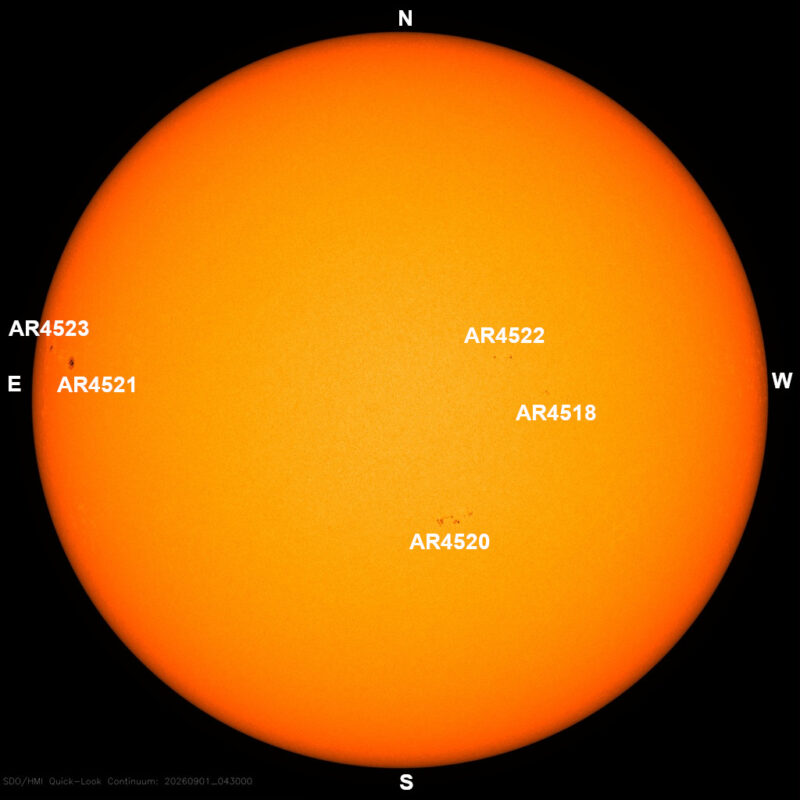
Sunspot regions: Currently, the Earth-facing solar disk displays five numbered sunspot regions, all relatively small and magnetically simple. Three newcomers received numbers during the period: AR4521, AR4522, and AR4523.
- AR4518 (beta): Stable, no flares produced during this period.
- AR4513 (beta): This region is now out of view, having rotated to the far side of our sun.
- AR4520 (beta): This region gained additional spots. It also produced the strongest flare of the period, a C2.6.
- AR4521 (alpha), AR4522 (beta), and AR4523 (alpha): These regions gained spots during the period but otherwise remained stable. Only AR4523 produced flares, contributing 2 C flares.
Blasts from the sun? Forecasters reported no Earth-directed coronal mass ejections (CMEs) in the last 24 hours.
Past 24 hours in space weather
Solar wind: Solar wind speeds slowly decreased from moderate to moderate-low levels, as the influence of a coronal hole high-speed stream began to wane.
Bt, Bz and magnetic coupling: The interplanetary magnetic field averaged at weak levels. Meanwhile, the Bz component fluctuated between south and north orientations. Even so, several sustained southward intervals dominated. A southward Bz favors auroras by letting solar wind energy couple more efficiently with Earth’s magnetosphere.
Earth’s magnetic field: Earth’s magnetic field showed quiet levels during the period, with the Kp index at 1 to 2. No significant aurora enhancements were expected at middle latitudes. Any visible displays would have stayed confined to high latitudes such as northern Scandinavia, Iceland, and northern Canada.
Sun news August 31: Fast coronal hole winds now easing

Earth’s magnetic field was stirred to active levels early in the past day as a stream of high-speed solar wind from a coronal hole continued to wash over our planet. However, that disturbance is now fading. Meanwhile, a large filament eruption in the sun’s northeast added a touch of drama. Forecasters are still analyzing coronagraph imagery to determine whether any of that material is headed our way.
Past 24 hours on the sun
(11 UTC August 30 – 11 UTC August 31)
Flare activity: Solar activity remained at low levels. Observers logged only 2 C-class (common) flares and several B-class (weak) events during the period.
- Strongest flare: A C2.2 from AR4513 at 16:41 UTC on August 30.
- Lead flare producer: AR4513 topped the list, responsible for the C2.2 plus a B9.8 event at 12:48 UTC on August 30.
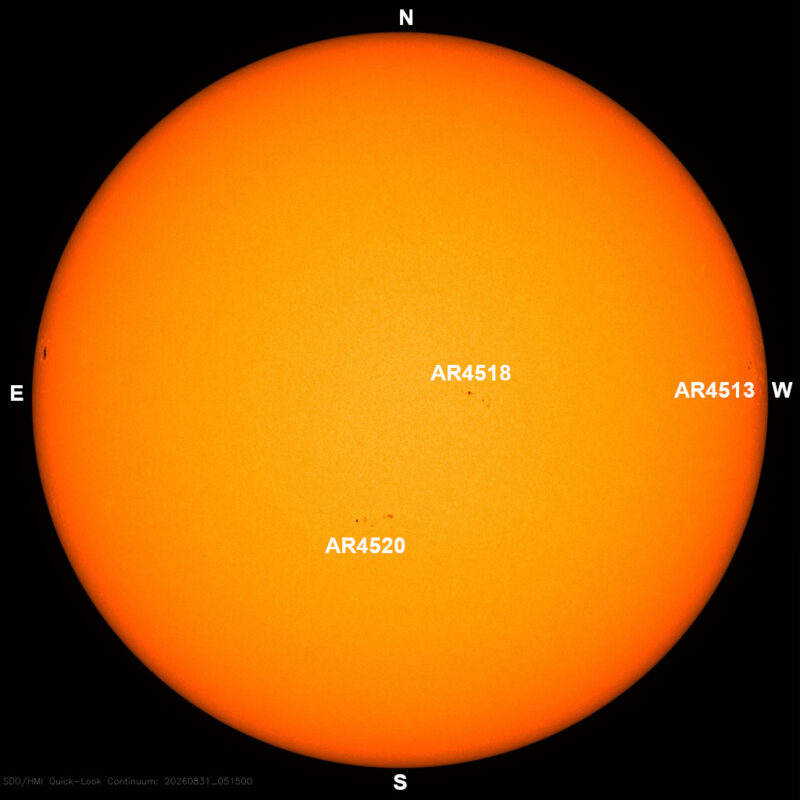
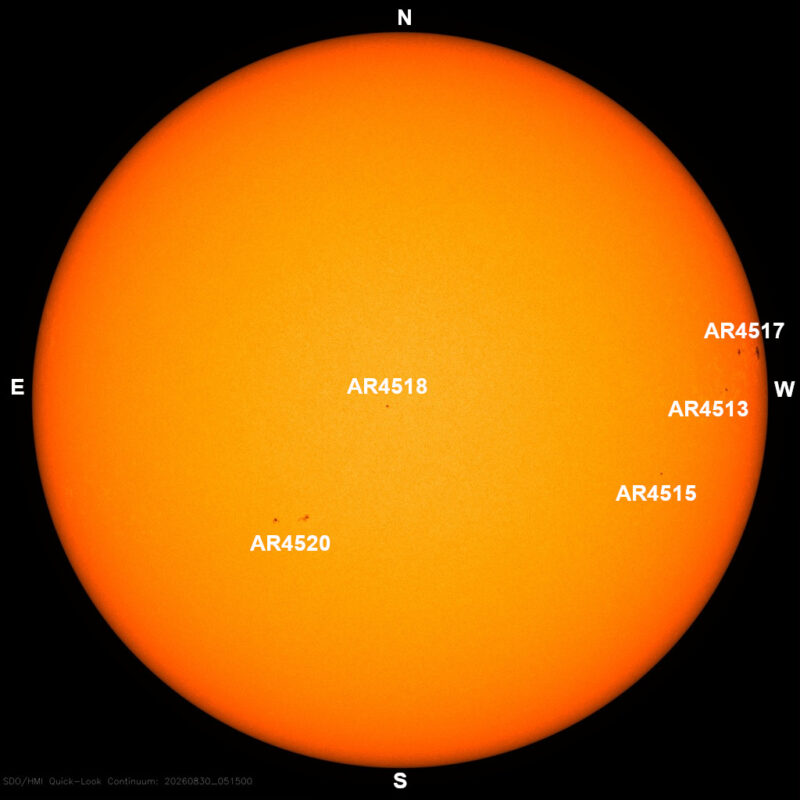
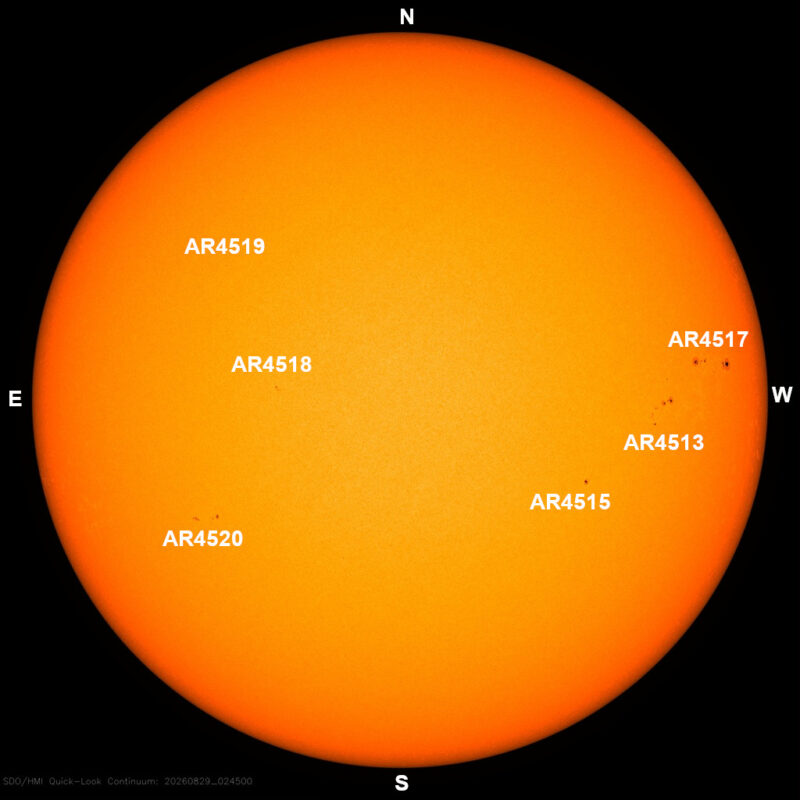
Sunspot regions: The Earth-facing solar disk displayed six numbered sunspot regions, all relatively small and magnetically simple.
- AR4518 (beta): This was the only region to show growth during the period. That makes it the most noteworthy spot group on the disk, despite its modest size.
- AR4517 (beta): This region is approaching the west limb. It should rotate out of view in the coming hours.
- AR4513 (beta): This region is also nearing the west limb. It produced the period’s strongest flare, the C2.2.
- The remaining active regions carried alpha or beta magnetic configurations. All were stable or decaying, and none produced significant flaring.
Blasts from the sun? No Earth-directed coronal mass ejections (CMEs) have been confirmed at this time. Observers spotted a large filament eruption in the northeast beginning around 6 to 7 UTC on August 30. Forecasters now await further coronagraph data to determine whether any associated CME carries an Earth-directed component.
Past 24 hours in space weather
Solar wind: Solar wind speeds stayed modestly enhanced under the continued influence of a coronal hole high-speed stream.
Bt, Bz and magnetic coupling: The interplanery magnetic field total strength peaked early in the period, then eased by the end. Meanwhile, the Bz component fluctuated erratically. Several sustained southward intervals drove the active geomagnetic conditions. As always, a southward Bz favors auroras by letting solar wind energy couple more efficiently with Earth’s magnetosphere. Conditions should gradually ease as the stream’s influence wanes.
Earth’s magnetic field: Earth’s magnetic field ranged from quiet to active levels during the period, driven by the coronal hole stream. The Kp index reached 4, placing conditions at the active threshold without crossing into G1 (minor) geomagnetic storm levels. The active intervals clustered during stretches of sustained southward Bz, while quieter spells arrived when the Bz turned northward. No significant aurora enhancement was expected at middle latitudes. Any visible displays would have stayed confined to high latitudes such as northern Scandinavia, Iceland and northern Canada.
The sun in recent days
Earlier sun images
Sun images from our community
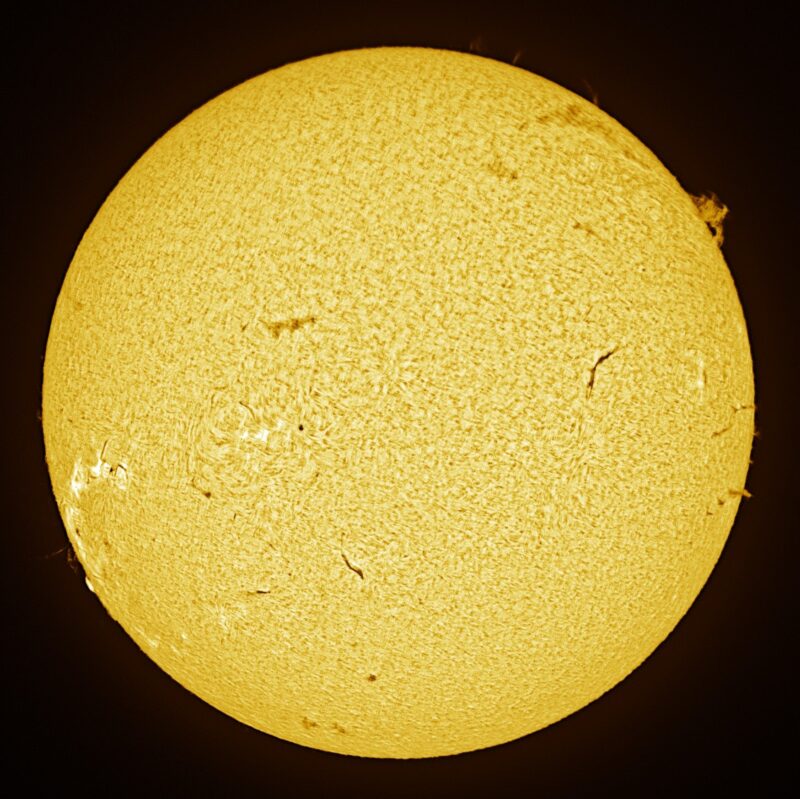
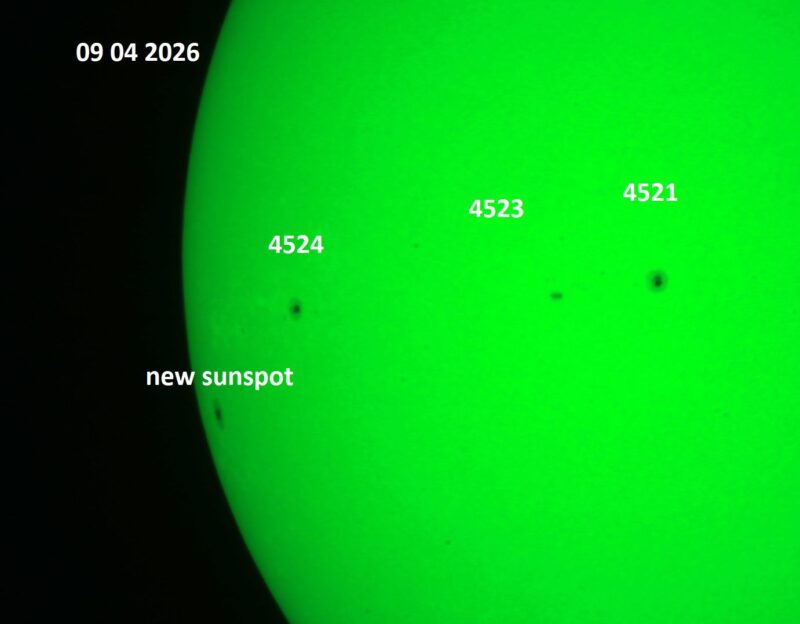
More sun images from our community
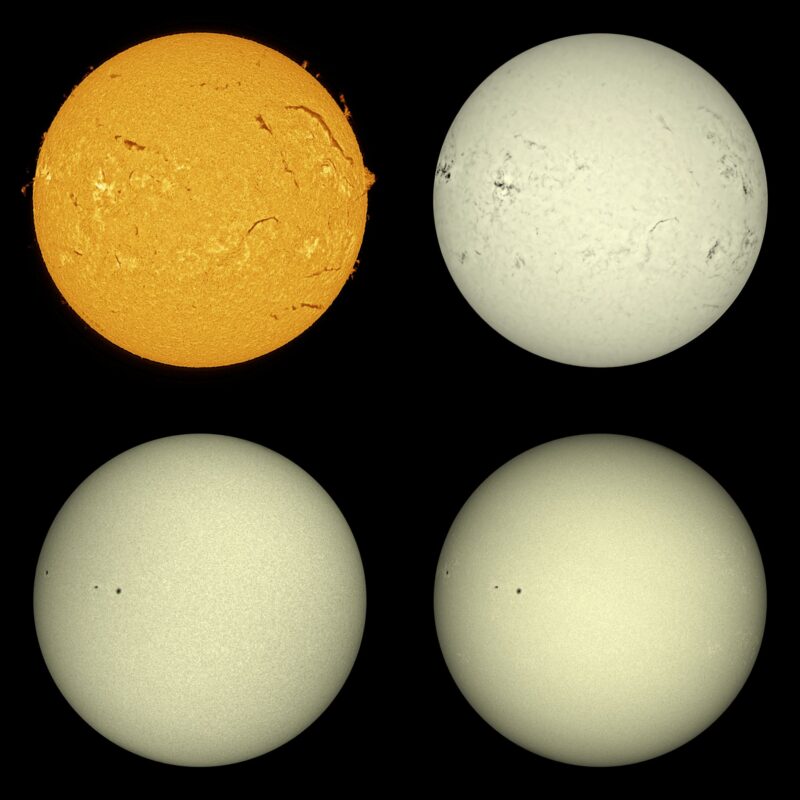
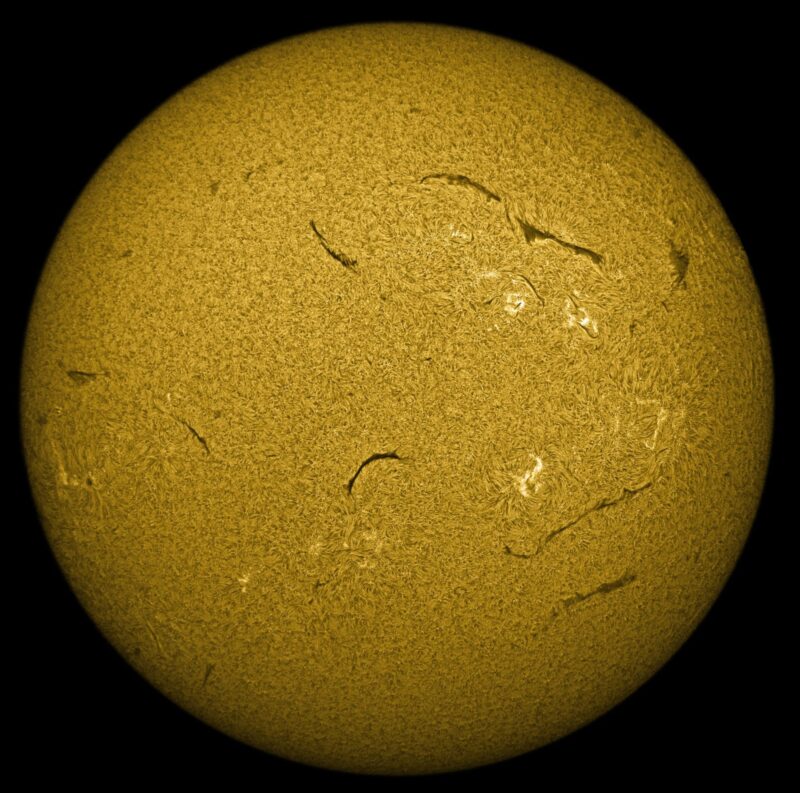
We sometimes feature sun images obtained using hydrogen-alpha filters. Read why.
Bottom line: Sun news September 5, 2026: Bam bam! Two eruptions in quick succession sent prominences soaring from both eastern limbs. Their CMEs look set to miss Earth.
Submit your photos here.
View community photos here.